

Token Retirement Party
I feel so old and so tired of this.

Hey You,
I don’t really feel like small talk this week. I can’t stop thinking about the photo of Nolan Wells circulating around. The one of him, a young Black man, sitting on a boat with his white supposed friends. Because there are no such things as coincidences, immediately after seeing this photo of Nolan Wells on instagram, I came across a photo of my son, Wes, posted on his summer camp instagram page in a sea of white children, all with their gummy gap tooth smiles. It’s a version of a million photos I’ve seen of me as a child. I am not going to pretend for a minute as though circumstances are that similar between Nolan Wells and myself or my child, because they are certainly not. For so many reasons. But what I know is that no matter how much I try to suppress it, ignore it, rationalize it or mock it, my soul understands that no Black, Mixed or Brown child is ever safe as the only one in white spaces.
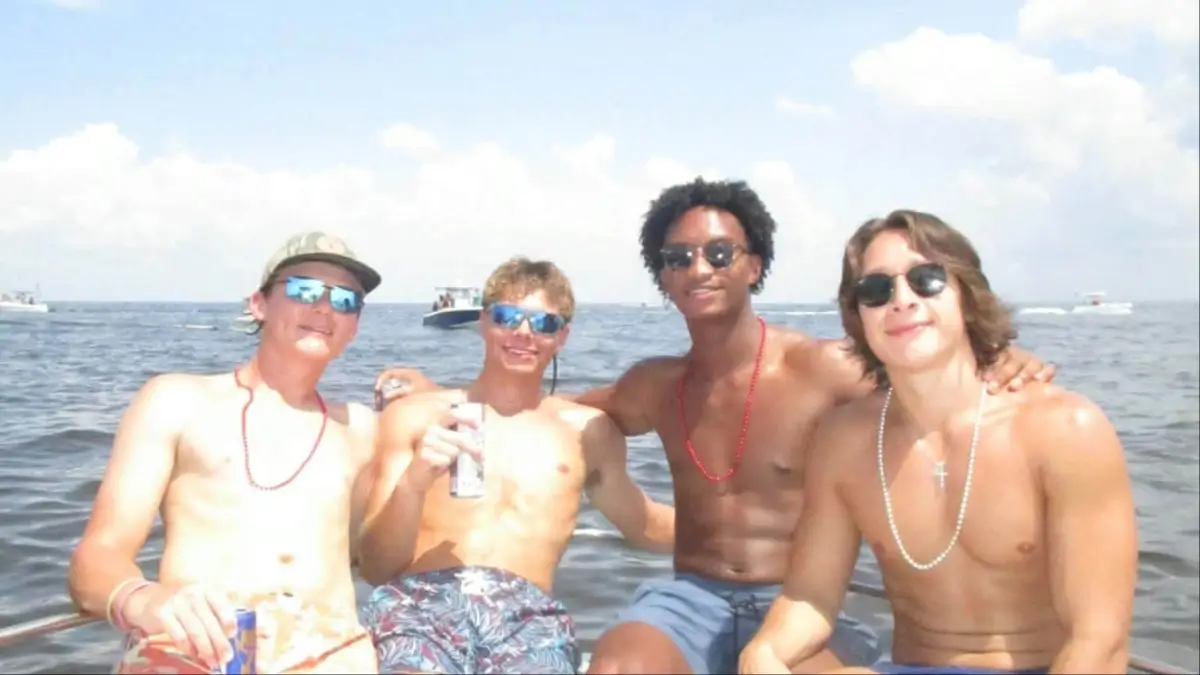
I am heartbroken, enraged, and determined more than ever hearing what we know and what we are still uncovering happened to Nolan Wells. And I’m finding myself at a loss of words for how to accurately describe how I’m feeling, in part because I think it stems from a conscience that developed when I was really young. If that makes any sense?
This is where my mixedness, my class, my family, and my upbringing are all extremely relevant and intertwined. I’ve grown accustomed to being in white spaces. And my trajectory of experience in white spaces always goes like some variation of this, I’m genuinely comfortable, I can do this, I’m fine, I’m being myself enough, this is fun albeit a bit surface level. Okay now I’m starting to lose a part of myself. A comment went sideways, a gesture feels harmful, there is a loosening of boundaries that is starting to make me feel unsteady. Now I’m scanning the room, did anyone else catch that? Who feels safe enough here? No other Black, Mixed people in sight, okay what about someone Brown? Queer? Someone who also floats in a specific marginal, privileged space and speaks a similar language? If I can’t find anyone who feels kindred, then I start to panic. Fear sets in. I wish I could describe this more accurately, but it’s really difficult. You’ll just have to trust me when I say it is a deep knowing that I am far away from myself. But that’s not quite it, either. It’s almost like I go through the phases of an allergic reaction that can quickly go from mild itchiness to my throat is seconds away from closing up.
This is a working revelation that I’m sure is not original: I think, in part, well meaning white people don’t grasp the severity of being the only one when the tables are turned (i.e. being the only white person surrounded by Black people or other POCs) because they don’t realize how much work goes in behind the scenes to making a space feel comfortable for them. Yes, they have systemic protections in place, but there’s something else. There is an accommodation factor. A care piece. And correct me if I’m wrong, but it is my observation that white people are not taught to look out for others, the way people of color are. Or maybe it’s that they’re not taught to look out for others who are not white. They rarely have to, so they rarely do it. I’m still processing all of this, but I’m starting to get closer to some understanding. It’s actually something I really experienced living in Costa Rica. Costa Rican women (Ticas) show up for others, especially children, in such a profound way. All children are not only revered, they are communally protected. I think that for many white people, there is more of an insular processing. Family is everything, but the concept of family is limited. And before you come for me, I knowww it’s not all white people. But it’s still by and large a common theme. Is this problematic speaking this generally? Maybe… I can’t decide, but if y’all are going to continue reminding me I’m half white, then I’m going to continue speaking on whiteness. Period. I really do fearfully wonder what the parents of Nolan Wells’ friends said and didn’t say to them before and in the aftermath of them leaving their one Black friend behind.
But I’m not going to center my experiences in this discussion anymore and feed (any more than I already have, oops) into the stereotypes about Mixed women inserting ourselves in conversations surrounding Blackness that are not ours to claim. Believe it or not, I'm in a stage of life where I’m tired of all the self reflecting. It’s important, of course, but it’s not energizing. Or changing anything. And it keeps me stuck and depressed. So instead, I’m moving towards action. Momentum. Something is better than nothing. I’m catapulting into my role and power as a mother, a wife, a daughter, a friend, a virgo rising with blind aries determination and a libra heart. And a therapist who wants therapy to feel more expansive, experiential and frankly, useful. What are we going to DO with what happened to Nolan Wells? What tangible changes need to take place? How do we honor his life and change the course for this next generation for the better? How can I position myself as a Black, Mixed person who is in community with a ton of white people to actually propel towards progress?
The author, Rebecca Carroll, recently re-posted on instagram something she wrote ten years ago that feels like a tangible starting place. As a Black, transracial adoptee in a white family, she has some incredibly painful and profound insight into what happens to Black and Brown children when they are the only ones. I want to create my own version of this list for my family and hopefully for other families with Black, Mixed children. Our version, I imagine, as with everything else, will be very nuanced, overlapping in some ways and differing in others. But this is somewhere to begin.
Rebecca Carroll:
As part of my keynote at the Pact Family Camp for families of interracial adoption at Lake Tahoe yesterday morning — I created this list, which I read aloud and was then asked for printed out by no fewer than 10 parents afterward. If you use it, give credit cc Damon Young, Roxane Gay, Ta-Nehisi Coates, and Issa Rae.
10 things for white adoptive parents of black kids to keep in mind right now:
Give your black children some black to grow on — black friends, black culture; work hard and tirelessly to make sure they are never the only one in the room, anywhere.
Find a black person to teach you how to manage your children’s hair and skin.
Do not judge any aspect of black culture that you don’t relate to or approve of, particularly in regard to pop culture — vet it first through black friends, folks, people. i.e. Beyonce’s Lemonade, the N-word. Check yourself on what makes it inappropriate to you.
Pay attention to Black Twitter — it knows everything.
Make sure you know who the following people are: Ta-Nehisi Coates, Amandla Sternberg, Damon Young, Roxane Gay, Bryan Stevenson, Ava Duvernay, Issa Rae, Rembert Browne, Kara Walker, Nikole Hannah-Jones, Kadir Nelson, Mickalene Thomas.
Don’t underestimate the power of black vernacular — and never, ever refer to it as ebonics or slang. Understand what it means to code switch.
Prioritize racial conversancy - the sense that a world can and does exist beyond the default of American whiteness.
Recognize and implement that black history is not a month, but every single day of our life in America.
Be prepared to be resented by your black children for your whiteness — it will manifest in a number of ways, be vigilant cultivating resiliency.
Realize that if in fact all lives mattered, the Black Lives Matter movement would not be necessary.
Important to note: Carroll wrote this list ten years ago, and as she stated in a recent instagram post, “TBT I would upgrade, revise, add several many more names to #5, and of course capitalize the B in Black, but 10 years later, numbers 1 and 10 still feel sadly and especially pointed.”
Rest in Power Nolan Wells. May your memory be a blessing and a prayer for us all.
Love,
Jesse